
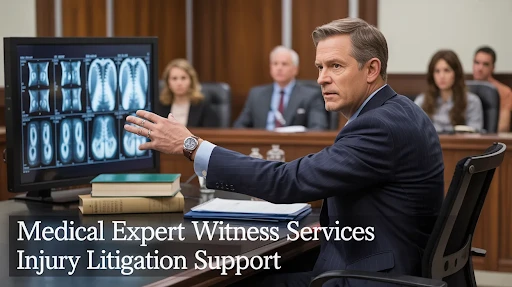
In serious injury litigation, medical expert witness services often decide whether the medical side of a case feels solid or shaky. Record-keeping alone is insufficient.
A stack of scans, treatment notes, operation reports, and billing entries may appear to be considerable, but there is no assurance that a jury, mediator, or opposing counsel would view the case the same way your side does.
Someone still has to explain what matters, what does not, and how the medicine connects to liability, causation, and damages.
That is where the right expert starts changing the case.
The Problem Is Usually Not Just Finding a Doctor
Lawyers do not usually struggle because they cannot locate a physician. The real problem is fit.
An orthopedic surgeon, a neurologist, a neuroradiologist, a pain expert, an emergency physician, a life care planner, or any combination of these may be required in a given situation. Pick too widely, and the opinion becomes generic.
Pick the wrong specialty, and opposing counsel will attack the match before the substance even gets going. Pick somebody technically qualified but poor at explaining things, and the case may still end up flat in the room.
That is why medical expert selection is rarely a background task in a hard injury case. It is strategy.
The right expert helps answer questions that actually move the case:
- Was the treatment appropriate?
- Does the mechanism of injury line up with the diagnosis?
- Are the claimed limitations supported by the record?
- What future care is medically necessary?
- Was there a departure from the standard of care?
Those answers carry weight only when the person giving them has clear clinical alignment with the issue in dispute. A jury may not know medicine, but they can usually sense when a witness is speaking from the center of their field and when they are drifting at the edges.
A Good Medical Expert Brings Order to a Messy File
Most injury files get messy long before trial. Treatment happens in different facilities. Providers use different terminology. Imaging gets read more than one way. Specialists disagree. Then there is timing, which is where plenty of causation fights live.
An experienced medical expert does more than offer a final opinion. They help sort the record into something usable.
That matters because lawyers often inherit chaos. One provider’s note may support the injury claim while another weakens it. Symptoms may worsen months later. There may be a prior injury in the background, or an unrelated condition muddying the picture. Without a disciplined medical review, the case theory can quietly start leaning on the wrong facts.
A strong expert helps narrow the actual issues. Not every abnormal imaging finding matters. Not every complaint belongs to the event being litigated. Not every treatment charge proves need. Sorting through that takes medical judgment, and it usually takes it early.
This is also why expert timing matters more than many teams like to admit. If the expert comes in too late, they may still write a report, but they have less chance to help shape the case before the theory hardens around weak assumptions.
Specialty Match Changes the Whole Presentation
This is where medical cases get won or lost in quieter ways.
A lawyer might know the case involves spinal injury, delayed diagnosis, chronic pain, or post-traumatic cognitive issues. That still does not answer which medical voice the case needs most. Sometimes the answer is obvious. Sometimes it is not.
For example, a disputed brain injury case may need more than one layer of review. The treating neurologist may explain symptoms and treatment. A neuropsychologist may address cognitive testing and functional change.
A neuroradiologist may be needed if imaging interpretation becomes a fight. Each of those experts serves a different role. Blend them carelessly, and the case gets muddy.
The same issue shows up in orthopedic and trauma cases. A surgeon may be ideal for explaining operative decisions and physical injury. A rehabilitation specialist may be better suited to talk about long-term function. A billing and coding expert may be necessary if treatment charges become their own battlefield.
That is why medical expert witness services are not really about filling a seat with a white coat. They are about matching the medical question to the right clinical lane.
Medical Records Alone Rarely Carry the Story
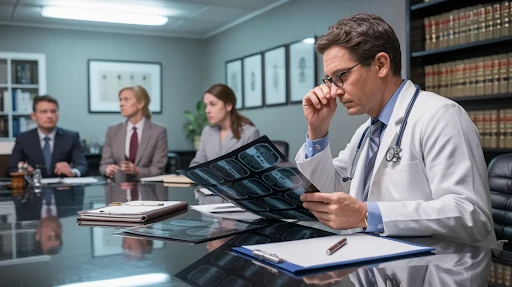
Lawyers know records matter, but records are not a story. They are fragments. Useful fragments, yes, but still fragments.
A jury may hear that the claimant suffered disc herniations, radicular symptoms, a limited range of motion, and continuing pain management. That doesn’t imply they comprehend what happened inside the body, why the symptoms make sense, or why specific treatment options are recommended.
The same is true for defense themes. Simply pointing to pre-existing degeneration or delayed complaints does not guarantee anyone will understand why those points matter medically.
This is where visual support often becomes more than a presentation choice. It becomes a clarity tool.
In the right case, courtroom animation services help translate a medical opinion into something a non-medical audience can actually follow.
That might mean showing how a fracture occurred, what a surgical procedure involved, how spinal structures were affected, or why a particular mechanism could or could not have caused the claimed injury. The goal is not flair. It is comprehension.
A visual only works when it stays loyal to the medicine. If it starts trying to do emotional work instead of explanatory work, it usually becomes a problem. But when the expert opinion is solid, and the demonstrative is restrained, the case gets easier to understand.
That matters more than lawyers sometimes realize.
Personal Injury Cases Need Medical and Physical Logic to Line Up
Personal injury litigation often turns on a simple question that becomes very complicated very fast: Does the injury claim make sense in light of the event?
That is not always easy to answer from records alone. A rear-end crash may produce a straightforward soft-tissue claim in one case and a heavily disputed surgical case in another. A fall may look minor until the claimant develops chronic pain, functional loss, or a treatment path that goes far beyond what the defense expected.
Medical experts help test those links. They look at mechanism, symptoms, imaging, treatment timing, prior history, and clinical progression. Then they answer the question underneath the lawsuit: is this a medically coherent injury narrative, or not?
That is also why some firms use personal injury animation services when causation and body mechanics are central to the dispute. A well-built visual can help connect force, movement, and injury in a way that testimony alone may not. It gives jurors a cleaner path into the medical explanation.
Still, none of that works without the right expert behind it. Animation cannot rescue a weak opinion. It can only help a strong one land.
Medical Malpractice Cases Are Even Less Forgiving
Malpractice cases leave less room for vague explanation. The medicine has to be sharp. The timeline has to be sharp. The standard of care issue has to be even sharper.
That is because these cases usually turn on a very specific failure point. A missed diagnosis. A delayed intervention. A surgical error. A medication issue. A failure to monitor. Once the claim gets that focused, broad medical language stops being helpful.
The expert has to be able to explain what should have happened, what happened instead, and why that difference caused harm.
That is a higher bar than many people realize. A witness can be an excellent physician and still be the wrong fit for a malpractice case if they cannot teach the issue clearly under pressure. Judges and juries do not need a lecture. They need a clean explanation rooted in the actual medicine.
This is one area where medical malpractice animation services can support the expert especially well. In the right case, a visual can show a treatment sequence, an anatomical error, or the progression of injury after a clinical failure. Used carefully, that kind of demonstrative makes the testimony easier to absorb without overstating the point.
Strong Cases Usually Build the Medical Story Early
The lawyers who handle medical issues well do not wait for the deadline panic stage. They bring the medical story into focus early enough to see where it holds and where it does not.
That means identifying the right specialty before discovery gets too far down the road. It means finding out whether the treatment path really supports the damages claim. It means understanding whether the imaging helps, hurts, or needs another set of eyes.
It means getting honest answers about causation before the case theme starts repeating itself in briefs and depositions.
That is the practical value of good medical expert work. It does not just help at trial. It helps prevent the case from being built on a medical theory that looks cleaner than the records actually support.
When Defense Counsel Needs Medical Expert Support
A lot of people still talk about medical experts as if they mostly belong to plaintiffs. That is not how real litigation works.
Defense teams use medical experts for a different reason, but often just as urgently. They require someone who can verify the stated injuries, treatment plan, and future suggestions. This may entail investigating pre-existing illnesses, treatment gaps, unrelated deterioration, alternate causes, or the distinction between what is feasible and what is medically plausible.
That work matters because injury claims can expand quickly. A case that starts with a straightforward complaint can turn into surgery, pain management, future care projections, and a much larger damages number than anyone expected.
Sometimes that growth is medically justified. Sometimes it is not. A defense expert helps sort that out without the case slipping into broad assumptions.
The stronger defense opinions are usually not the ones that reject everything. They are the ones that narrow the case carefully. They concede what the records support, then explain where the claim goes too far.
Some Cases Need the Medical Story and the Event Story to Fit Together
Medical causation does not always stand on medical records alone.
The injury story in automobile crashes, workplace occurrences, and other stressful events frequently relies on how the event occurred. If the mechanics of the occurrence do not match the alleged injury pattern, the medical case begins to erode. If they do line up, the causation argument gets stronger.
That is why some matters benefit from both medical review and event reconstruction. In those cases, accident reconstruction animation services can help bridge the gap between the physical event and the medical opinion.
The reconstruction explains movement, timing, impact, and sequence. The medical expert explains what those forces could plausibly cause. When the two fit together, the overall case becomes far easier to understand.
That combo can be effective, but only if it remains disciplined. If the reconstruction goes beyond the data, or the medical judgment goes beyond the mechanism, the presentation loses credibility. The components must support each other, not simply sit next to each other.
Frequently Asked Questions
What Are Medical Expert Witness Services?
Medical expert witness services involve using qualified healthcare specialists to review records, form opinions, and explain medical issues in a legal case. That may include causation, standard of care, prognosis, future treatment, billing, imaging, or long-term impairment.
When Should a Lawyer Retain a Medical Expert?
Usually as early as the medical issues start shaping case value or case risk. Early expert review can help with causation, damages, discovery strategy, record gaps, and whether the claimed treatment path is medically supportable.
Do Medical Expert Witness Services Only Help Plaintiffs?
No. Defense attorneys frequently employ them to examine injury claims, analyze treatment needs, contest inflated future care, assess pre-existing conditions, and react to plaintiff expert views with limited or alternative medical analysis.
What Types of Cases Commonly Need Medical Experts?
They are frequently utilized in personal injury, catastrophic injury, medical malpractice, workers’ compensation, wrongful death, product liability, and insurance disputes over diagnosis, treatment, disability, or future medical requirements.
Can Medical Experts Work Alongside Legal Demonstratives?
Yes. Medical specialists frequently collaborate using timelines, images, and animations while working on medically complex cases. The expert expresses his or her viewpoint, and the demonstration assists the court in better understanding the explanation.
Final Words
Medical expert witness services are important since injury lawsuits typically rely on more than just records and diagnostic codes. The case requires a medically competent explanation of what occurred, what therapy makes sense and what does not, and how those opinions relate to the legal problems being litigated.
The best outcomes are typically achieved through the correct specialist match, early engagement, rigorous coordination, and a presentation that helps the court grasp the treatment without exaggerating it.