
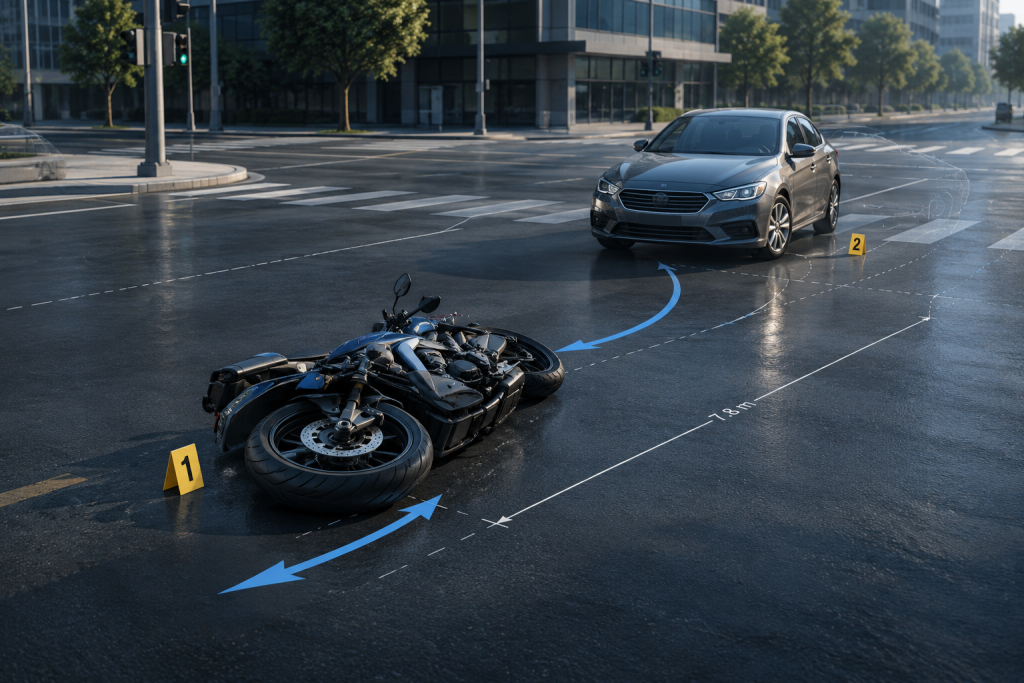
The motorcycle cases often turn on details that most jurors have never experienced: how far a bike can lean into a turn, how hard a rider can brake before he falls, and how small a headlight can appear to a driver waiting to turn left. Those details are described in words in testimony. Words wear out a jury quickly.
An animated motorcycle accident reconstruction takes the expert’s conclusions and puts them into a scaled, moving 3D scene that jurors can watch. Here, we cover what it shows, why bike crashes are harder to explain, the evidence behind it, where it beats testimony, and what it costs.
Need a Clearer Picture of Your Accident Case?
Show exactly how a motorcycle accident unfolded with professional 3D accident reconstruction animation. Turn complex crash evidence into clear, compelling visuals for your case.
What a Motorcycle Accident Reconstruction Shows When It’s Animated
It’s a computer simulation of the crash. Each move is based on the reconstructionist’s numbers for speed, position, timing, and angle. Each frame should be based on a measurement, a photo, a data file, or an assumption clearly marked as such.
That traceability is the whole idea. A good animation does not add drama the record won’t support. It shows what the expert has already concluded, in a form a layperson can follow.
Most motorcycle projects involve some combination of these views:
- An aerial view showing lane positions, sight lines, and the paths of both vehicles.
- A driver’s-eye view from inside the car, showing jurors what was visible at the moment the turn began.
- Rider view of how much road and time the motorcyclist had left.
- Last 2 or 3 seconds in slow motion, speeds and distances shown on screen.
Think of it as the expert’s take on the move. If you’re curious about how the two work together, our breakdown of animation and expert witness testimony in tandem goes deeper.
Why Motorcycle Crashes Are Harder to Explain Than Car Crashes
The stakes are high here, and the physics are unfamiliar to most jurors. NHTSA reported that 6,335 motorcyclists were killed in 2023, representing 15% of all traffic deaths. The fatality rate per mile traveled for motorcyclists was almost 28 times higher than that for passenger car occupants. In 46 percent of fatal two-vehicle crashes involving a motorcycle, the other vehicle was making a left turn. In those cases, both sides fight over speed and visibility.
Here’s what makes these cases hard to picture:
- Lean steer. A motorcycle turns by leaning and countersteering. Car drivers think in steering wheels. To them, a rider’s evasive swerve can look like a mistake.
- Braking isn’t easy. Riders work the front and rear brakes separately, and a locked front wheel can drop the bike. “Why didn’t he just stop?” That’s a technical question that’s hard to answer from the witness stand.
- The bike is difficult to see. With just one headlight and a narrow profile, it’s hard to gauge distance and speed. Most multi-vehicle motorcycle crashes happen because other drivers didn’t see the rider, according to NHTSA.
- Rider and machine parted on impact. The bodies are two, and they are on two paths. A flat scene diagram doesn’t usually make that clear.
- Speed is attacked. According to NHTSA data, 36% of riders in fatal crashes were speeding, compared to 22% of car drivers. The defense is going to bring it up whether the evidence supports it or not.
Bring Your Motorcycle Accident Evidence to Life
Transform accident reports, vehicle damage, and scene measurements into detailed 3D animations that help attorneys and juries understand how a collision occurred.
The Evidence an Animator Needs Before Building the Scene
The quality of an animation is entirely dependent on the quality of its inputs. Get moving and get your hands on these before the vehicles are repaired or scrapped:
- The police report, scene diagram, and measurements taken by responding officers.
- Scene photos, drone images, or a laser scan of the road, including grade, curve radius, and sight obstructions such as parked trucks or hedges.
- Footage from dash cams, local businesses, traffic cameras, or a helmet cam.
- Car crash data. In many cars, airbag control modules are capable of storing about five seconds of pre-crash speed, throttle and brake data, and the change in velocity the car underwent during impact.
- Tire scuff marks, frame damage, crush depth, and motorcycle speedometer reading.
- Helmet and riding gear, because the scrape marks indicate the movement of the rider’s body after separation.
- A full copy of the reconstructionist’s report, with calculations that the animator can check frame by frame.
Many bikes don’t even have a crash recorder. That’s why the information from the car and the physical evidence is so crucial, and why losing either creates a hole no animator can fill in good faith.
How Animation Shows a Jury What Testimony Alone Can’t
Legal scholars have long pointed to research showing that jurors remember only 10% to 20% of what they hear, but 65% to 80% of what they see. In a motorcycle case, that gap shows up in certain places:
- Time becomes visible. Jurors hear that the driver had less than two seconds, and it sounds abstract. Seeing those two seconds play out in real time, from the rider’s perspective, is a very different feeling.
- Jurors take the wheel. You can put them in the driver’s seat of a turning car and have them judge whether the headlight was visible from behind a pickup or a windshield pillar.
- Competing versions sit side by side. If the defense says the rider was doing 55 and your expert says 38, the two can run together, and the jury sees which one fits the skid marks and crush.
- Experts stay grounded. A reconstructionist who walks the jury through frames, stopping right at impact and again at the point of no return, is easier to follow and much harder to knock off course on cross-examination.
- It travels. The same visuals can be used for mediation, adjuster meetings, and depositions well before a jury is seated. Those pretrial uses are covered in our guide to what attorneys should know about traffic accident animation.
One limit is important. The judge decides whether to admit an animation, and opposing counsel will challenge it against the record. Research admissibility of courtroom animation and talk to your reconstructionist early about what the animation will and won’t show.
What a Motorcycle Crash Animation Costs
There’s a plan for two pieces of legislation, one for the reconstruction, and one for the visual built on top of it. A simple reconstruction will typically cost between $2,500 and $7,500, with complicated cases costing more than $10,000. Plus expert time. The median hourly rate for file review is $450, depositions $475, and trial testimony $500, according to SEAK’s 2024 survey of more than 1,600 experts.
And then there’s the visual. Courtroom animation can cost $5,000 or more depending on the detail, and full trial packages climb from there, according to the ABA Journal. In one published trial budget, a plaintiff’s attorney allocated $42,000 for blowups, demonstratives, graphics, and trial technician fees in a two-week auto case.
| Scope | What you get | Typical range |
| Scene exhibit | A scaled overhead diagram or 3D still showing positions at impact | $1,500 to $5,000 |
| Mediation animation | 30 to 60 seconds, one or two viewpoints, one version of events | $5,000 to $15,000 |
| Trial animation | Several viewpoints, rider and driver perspectives, competing scenarios, expert-checked revisions | $15,000 to $50,000+ |
The most important factors that affect the price are: length, number of viewpoints and scenarios, level of detail in the scene model, revision rounds, and your deadline. A fast-tracked timeline before expert disclosure almost always costs more.
Final Thoughts on Putting the Crash in Front of the Jury
A motorcycle accident reconstruction provides you with the numbers. Animation turns those numbers into a sequence that a jury can watch, pause, and replay. That matters when the facts depend on lean, braking, and a few feet of visibility. Build every frame from the record, keep both vehicles, start early.
For years, Legal Animation has been turning crash data and expert findings into visuals attorneys can use at mediation and trial. If you are involved in a motorcycle case, our accident reconstruction animation services can assist you in deciding on the appropriate level of detail for your budget and deadline.
Make Every Detail of Your Accident Case Clear
Help legal professionals communicate complex motorcycle accident scenarios with precision. Our 3D accident reconstruction animations turn technical evidence into realistic visual stories that make collision sequences easier to understand.
Frequently Asked Questions
Is a motorcycle accident reconstruction animation admissible in court?
It can be, but the judge gets to decide. Courts generally look for an animation that is consistent with the evidence, has the backing of a qualified expert, and would not mislead jurors about what actually happened. Rules differ by jurisdiction; check yours early.
How much does a motorcycle accident reconstruction cost?
A simple reconstruction usually costs $2,500 to $7,500, and complex cases can cost more than $10,000. Animation is an additional cost that starts at around $5,000 and goes up with detail.
How long does it take to make a crash animation?
A brief mediation can take a few weeks. Often a couple of months is needed for a trial animation with several viewpoints and expert revisions. Start well before disclosure deadlines.
Can a reconstruction show how fast the motorcycle was going?
Usually yes, a range, not a single number. Experts use the car’s crash data, tire marks, crush damage, video and, on some bikes, an onboard recorder.
Who pays for accident reconstruction in a motorcycle case?
Insurers keep their own experts. Many firms front the cost on the injured rider’s side, and it is repaid from any settlement or award.
Related Articles:
- Accident Reconstruction Animation vs Expert Witness Testimony
- Will a Judge Admit a Crash Reconstruction Animation
- Accident Cases that Benefit from Legal Animation