
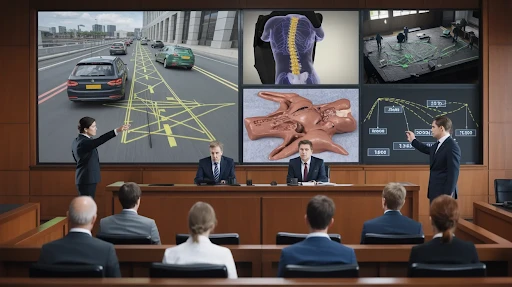
Is courtroom animation admissible as evidence? It is possible, but there is no guarantee. A judge will review the animation and offer some practical questions.
Is it founded on facts? Is it fair to both parties? Does it assist the jury in grasping something important? Or does it make the case appear more dramatic than it actually is?
That is the heart of it.
Courtroom animation can help in a number of situations. It can show how an accident happened, a person was injured, a medical error occurred, or a machine failed. However, it must be consistent with the record. If it starts presenting things that no witness, expert, report, or document can support, the opposing party will most certainly complain.
What Courtroom Animation Actually Does
A courtroom animation is a visual explanation.
It might depict movement, time, injury, damage, medical procedures, product failure, or the sequence of events. Simply put, it allows people to see what a witness is talking about.
Take a car crash case. An expert can talk about speed, braking, lane position, and impact point. Some jurors will follow it. Others may struggle. A short animation can make that same explanation easier to understand.
The same idea applies in a medical case. A doctor may explain a surgical injury or a missed diagnosis. A visual can show the body part, the step in the treatment, or the injury in a way the jury can follow.
A good animation does not replace the witness. It helps the witness explain the point clearly.
Is It Evidence or a Visual Aid?
This is where people often get confused.
Many courtroom animations are used as demonstrative evidence. That means they explain other evidence. They are like a chart, timeline, model, or diagram. They are there to help the jury understand testimony, not to become the whole case by themselves.
For example, a doctor may use an animation while explaining an injury. An accident expert may use one while explaining vehicle movement. A product expert may use one to explain how a part broke.
In that kind of use, the animation supports the evidence. It does not replace it.
The judge will still want to know if the animation is fair, accurate, and informative. If it aids the jury’s understanding of the testimony, it has a stronger probability of being admitted.
Why the Purpose Matters
The court will want to know what the animation is supposed to do.
Is it just explaining a witness’s opinion?
Is it showing a general process?
Is it showing one side’s version of an event?
Is it being presented as an exact recreation?
Those are not the same thing.
A simple animation that explains how an injury works may be easier to allow. A full crash recreation may face closer review because it can look very real. If the jury sees it and thinks, “This is exactly what happened,” the judge may want to know what facts support every important detail.
That is why a legal team should work with a courtroom animation company that understands court use. A good-looking animation is not enough. It has to be fair, careful, and easy to explain.
The Animation Has to Come From the Case Record
A courtroom animation should not be built from imagination.
It should come from real case material. This may include images, medical records, police reports, product designs, scene measurements, video footage, expert opinions, or deposition testimony.
If the animation shows a vehicle turning at a certain point, there should be a reason for that. If it shows an injury inside the body, a medical expert should be able to support it. If it shows a machine part breaking, the product expert should be able to explain why that view is fair.
This is where objections often start.
The other side may say the animation shows facts that were never proven. They may say it leaves out important details. They may say it makes one side look too good or too bad.
A strong animation is easier to defend because the legal team can point to the evidence behind it.
Personal Injury Animations Need Medical Support
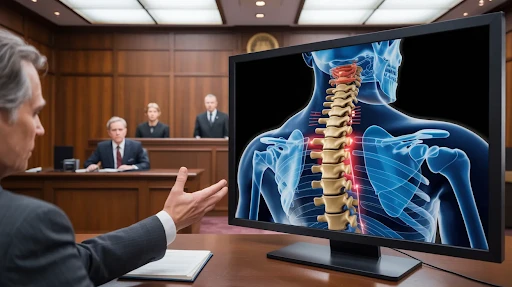
In personal injury cases, the injury is not always easy to show.
Someone may have neck pain, back damage, nerve injury, head trauma, or internal harm. The jury may understand that the person is hurt, but still not understand how the accident caused the injury.
That is where personal injury animation services can help. A simple pictorial representation can demonstrate how the body moved after a fall, accident, or impact. It can demonstrate how force affects the spine, shoulder, knee, head, or any other body component.
But the animation must match the medical evidence.
If the doctor says one thing but the animation indicates another, there is a problem. If the animation makes the damage appear worse than the records indicate, this might be an issue.
The safest personal injury animation is simple. It should be easy for the expert to explain and easy for the jury to understand.
Medical Malpractice Animations Need a Careful Hand
Medical malpractice cases are often hard because the facts are medical.
The case may involve a missed diagnosis, a surgery mistake, delayed treatment, or poor monitoring. These issues may be clear to doctors but confusing to jurors.
Medical malpractice animation services can help show the medical steps in order. The animation may show the body part involved, the treatment that should have happened, or the point where something went wrong.
But the visual should not be scary. It should not use dramatic effects. It should not make the doctor look careless unless the evidence supports that point.
A good medical animation feels like a clear lesson. It helps the jury follow the medical issue without turning the case into a show.
That matters. A judge may be more cautious with a visual that feels emotional or unfair.
Accident Animations Are Often Challenged
Crash animations can be powerful. That is why they are often challenged.
They may show speed, braking, lane position, turning, visibility, reaction time, and point of impact. A jury may remember that animation more than the spoken testimony.
So the court may ask how it was made.
If lawyers use accident reconstruction animation services, the animation should follow the accident expert’s opinion. It should be based on real information where possible. That may include road measurements, vehicle damage, police reports, photos, video footage, or black box data.
The animation should not fill in missing facts just to make the scene look smoother.
If a fact is disputed, the animation should not pretend it is certain. That is one of the quickest ways to create a fight over admissibility.
Demonstrative Evidence Should Stay Focused
A courtroom animation should usually make one point clear.
It should not try to explain the whole case at once. When a visual includes too many details, the jury may stop following it.
One animation can show the accident sequence. Another visual can show the injury. A timeline can show the order of events. A product animation can show how one part failed.
That is where demonstrative evidence services can help. The goal is not to make the fanciest video in the room. The goal is to make a hard point easier to understand.
A good visual should make the jury think, “Okay, now I see it.”
That is the job.
FAQs
Is Courtroom Animation Admissible as Evidence?
Yes, it can be admissible, but the judge decides. The animation must be fair, useful, and based on real evidence.
Is Courtroom Animation the Same as Demonstrative Evidence?
Yes, this happens a lot. Many courtroom animations serve as demonstrative evidence, explaining testimony, injuries, accident sequences, expert views, and timetables.
Can the Other Side Object to Courtroom Animation?
Yes. The other side may object if the animation is unsupported, unfair, too emotional, inaccurate, or likely to confuse the jury.
Does Courtroom Animation Replace Expert Testimony?
No. The expert still gives the opinion. The animation only helps the jury see what the expert is explaining.
What Makes Courtroom Animation More Likely to Be Allowed?
It is beneficial when the animation is straightforward, based on genuine information, vetted by specialists, and utilized to communicate facts without adding unnecessary drama.
Final Words
So, is courtroom animation admissible as evidence? It might be, but the court will make the decision. The animation must be fair, straightforward, and based on real-world facts. It should explain testimony, not replace it.
It should not add drama or show details that cannot be supported. The strongest courtroom animation is simple, careful, and easy for the expert to explain.
Related Articles: