
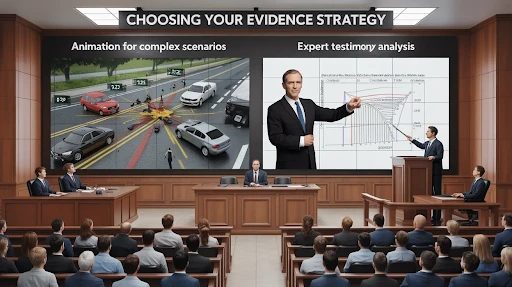
Accident reconstruction animation vs. expert witness testimony is not about picking one and leaving the other out. They do different jobs. The expert gives the opinion. The animation helps the jury see what that opinion means.
In a simple crash case, spoken testimony may be enough. In a more complex case, especially one with timing, speed, braking, sight lines, or multiple vehicles, animation can make the explanation much easier to follow.
The real question is not “which one is better?” The better question is, “what does the jury need in order to understand this crash?”
Expert Testimony Is the Starting Point
An accident reconstruction expert is usually the person who explains how the crash likely happened.
They may examine police reports, photographs, skid marks, road layouts, car damage, video footage, black box data, witness accounts, and scene measurements. Following that, they formulate an opinion.
That opinion matters. It is the base of the case.
An animation should not come first and then look for support later. That is backwards. If the animation depicts a car turning, braking, speeding up, or colliding with another vehicle at a specific angle, the expert should be able to explain why such movement is acceptable.
A jury may like the animation because it is easier to watch than technical testimony. Still, the expert is the one who gives it meaning. Without the expert’s support, the visual can look like guesswork.
What Animation Can That Testimony Cannot Always Do
A crash happens fast. Sometimes it takes only a few seconds.
That is why it can be hard for jurors to understand from words alone. A lawyer may explain the same point three different ways and still see confusion on people’s faces.
Animation helps with that problem.
It can show where each vehicle was before impact. It can show how far a truck traveled before braking. It can show when a pedestrian enters the roadway. It can show what a driver could or could not see.
This is where a courtroom animation company can help. The job is not to make the crash look dramatic. The job is to make the movement clear.
A good animation gives the jury a clear view of the event. Not a movie. Not a guess. Just a clear visual version of the expert’s opinion.
When Testimony Alone May Be Enough
Not every case needs animation.
Sometimes the crash is easy to explain. Maybe there are only two vehicles. Maybe both sides agree on the basic sequence. Maybe the main issue is not how the crash happened, but how badly someone was hurt or how much money the claim is worth.
In that kind of case, expert witness testimony may be enough.
The expert can use photos, a simple diagram, a chart, or a map. They can explain speed, damage, and impact without needing a full moving visual. That can save time and cost.
Using animation just because it looks impressive is not always smart. If it does not make the case easier to understand, it may only add extra noise.
Good trial work is not about using every tool. It is about using the tool that fits the problem.
When Animation Makes the Expert Easier to Follow
Some crashes are not easy to picture.
Think about a multi-vehicle pileup. Or a truck crash where stopping distance matters. Or a motorcycle accident where lane position is disputed. Or a pedestrian case where visibility and reaction time are important.
In those cases, the expert may be right, but the jury may still struggle to follow the explanation.
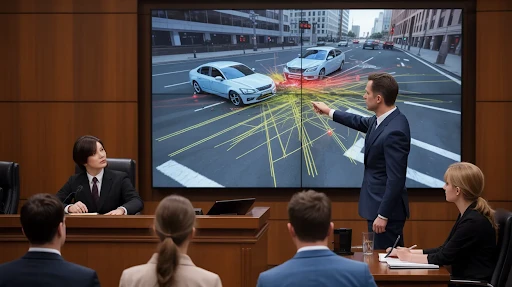
That is when accident reconstruction animation services can be useful. The animation gives the jury a visual path while the expert talks through the opinion. People can see the vehicles, the timing, the distance, and the impact point.
This helps because most jurors are not accident experts. They may not understand crash diagrams. They may not know how long it takes a truck to stop. They may not think about sight lines or reaction time.
A simple animation can make those ideas easier to understand.
The Main Difference Is Opinion vs. Visual Explanation
Here is the easy way to look at it.
The expert explains what happened.
The animation shows that explanation.
The expert may say, “Based on the data, Vehicle A entered the intersection before Vehicle B had time to stop.” The animation can demonstrate the scenario in a way that the jury understands more rapidly.
But the animation should not add new facts. It should not guess. It should not show anything the expert would not support under questioning.
If the animation becomes its own version of the crash, separate from the expert’s opinion, that is a problem.
The safest animation is one that feels like a visual aid for the expert, not a separate argument.
Personal Injury Cases May Need More Than Crash Movement
In many crash cases, lawyers are not only explaining the accident. They are also explaining the injury.
That can be a separate challenge.
The jury may understand that two vehicles hit each other. But they may not understand how that impact caused a neck injury, back injury, shoulder injury, head trauma, or nerve damage.
This is where personal injury animation services may help. A crash animation can show the vehicle’s movement. A separate injury animation can show how the body moved and why the injury makes sense.
The two should match. If the crash animation shows one kind of impact and the injury animation suggests something else, the presentation can feel confusing.
When they work together, the jury can understand both parts: the event and the injury.
Medical Issues Need a Different Kind of Animation
Some legal cases move away from the crash itself and focus more on treatment.
A person may need surgery after an accident. There may be a delayed diagnosis. There may be a dispute over nerve damage, internal injury, or whether the treatment was done properly.
That is not really an accident reconstruction issue anymore. It becomes a medical explanation issue.
That is where medical malpractice animation services can help. Medical animation can show anatomy, treatment steps, injury progression, or what happened during care.
This kind of visual should be checked by a medical expert. A crash expert may understand movement and force, but they are not the right person to approve medical details.
The source material is different. The expert review is different. The risk is different, too.
Demonstratives Should Stay Focused
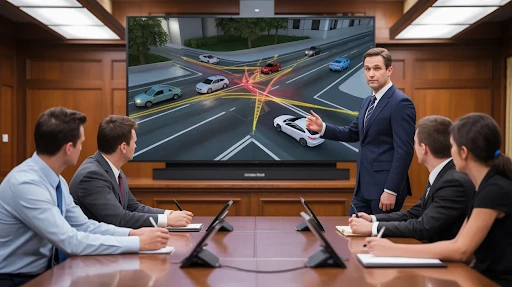
Accident animation is often used as a demonstrative aid. That means it helps explain evidence that already exists.
It should not try to carry the whole case.
A crash animation can show vehicle movement. A timeline can show the order of events. A medical visual can explain the injury. A chart can compare stopping distances.
Each visual should have one job.
That is where demonstrative evidence services can help. A legal team may need several simple visuals instead of one crowded animation trying to do everything.
The simpler the visual, the easier it is for the jury to follow.
Frequently Asked Questions
What Is the Difference Between Accident Reconstruction Animation and Expert Witness Testimony?
Expert witness testimony clarifies the opinion. Accident reconstruction animation graphically represents that opinion, allowing the jury to grasp crash action, time, and sequence.
When Should Lawyers Use Accident Reconstruction Animation?
Lawyers should utilize it when the accident is difficult to convey using words, images, or diagrams alone. It improves speed, braking, visibility and prevents multi-vehicle collisions.
Can Expert Witness Testimony Be Enough Without Animation?
Yes. In simple cases, a clear expert explanation with photos, charts, or diagrams may be enough.
Does Accident Reconstruction Animation Replace the Expert?
No. The expert still explains the opinion. The animation only helps the jury see what the expert is describing.
What Makes Accident Reconstruction Animation Strong in Court?
It should be based on real evidence, reviewed by the expert, easy to follow, and free from extra drama or unsupported details.
Final Words
Accident reconstruction animation vs. expert witness testimony is not a choice between two competing tools. Expert witness testimony gives an opinion. Accident reconstruction animation helps the jury see that opinion more clearly. Testimony may suffice in basic circumstances.
Animation is useful when the crash includes movement, timing, speed, visibility, or a difficult-to-imagine sequence. The greatest results are typically obtained when the expert, legal team, and animation team all work with the same material and keep the visual simple.
Related Articles: