
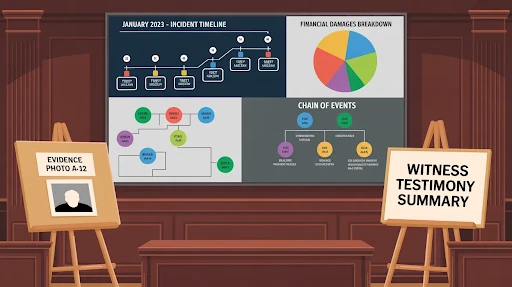
In complicated issues, trial graphics do considerably more than make a presentation appear professional. They assist legal teams with translating a complicated case record into something that judges, juries, and arbitrators can understand. That sounds simple, but it is usually where a lot of cases start slipping.
The facts may be strong. The experts may be solid. The documents may be there. Still, if the story is hard to see, the argument gets harder to hold onto.
That is why visual communication matters so much in modern litigation. People do not just need information. They need structure.
Good Cases Can Still Feel Hard to Follow
A legal team may know the case inside out. They know the record, the sequence, the witness problems, the technical issues, and the weak points on the other side. None of that guarantees the audience will absorb the case in the same way.
That gap shows up all the time.
A product case may depend on engineering details the jury has never encountered. A business dispute may involve a timeline spread across years of emails, agreements, and internal decisions. An injury case may rely on medical records, scans, and expert testimony that make sense to the lawyers and doctors but not to a room full of non-specialists.
This is where trial graphics start doing real work. They help organize what matters. They strip away some of the noise. More importantly, they help legal strategy land in a form people can retain.
That is the part many teams underestimate. Comprehension is not automatic. Even intelligent viewers lose track of the story when too much information enters in the incorrect sequence or manner.
Visuals Help the Audience See the Case, Not Just Hear It
Most people process a complicated story better when they can see its shape.
That does not mean every case needs a dramatic presentation. It means the case needs a presentation that matches the complexity of the problem. In some matters, that is a clean sequence chart. In others, it is a technical tutorial.
In others, it is a fuller visual package built around trial presentations that support the theory of the case from opening through witness testimony.
This matters in bench and jury trials, but it matters well before trial too. Lawyers use visuals in mediation and arbitration, in internal strategy sessions, and in focus groups and mock trials when they need to test what is landing and what is not. A case often sounds clearer in the conference room than it does when real people hear it cold for the first time.
That is where smart graphics become less of a design decision and more of a case decision.
The Best Trial Graphics Support the Story Instead of Fighting for Attention
This is where some legal teams go wrong. They hear “graphics” and start thinking about style before function. In litigation, that order should be reversed.
The finest visuals aren’t the busiest. They are the ones who simplify the argument while keeping the focus on the subject. A good visual should assist the audience in understanding the sequence, comparison, scale, anatomy, process, or change over time. It should not feel like it is trying to win the case by itself.
That is one reason many firms work with a courtroom animation company when the dispute has technical or spatial issues that are hard to explain verbally. The animation is not there to impress people with production value. It is there to make difficult facts easier to follow.
That distinction matters in front of judges as much as juries.
Some Cases Need Motion, Not Just Static Exhibits
There are facts that a still image cannot explain well.
Movement is one obvious example. Timing is another. Process is another. If a case depends on how something unfolded over seconds, how a body moved during impact, how machinery failed, or how a sequence of medical events led to injury, the legal team may need more than a board or slide.
That is why 2D animation and 3D animation remain such important tools in complex disputes. A strong 3D trial animation can clarify a chain of events in a way that spoken explanation often cannot. It gives shape to cause and effect. It also helps fact-finders hold onto the sequence when opposing counsel starts trying to break it apart.
This becomes especially useful in cases involving vehicle movement, point of impact, line of sight, and body mechanics. In those matters, a traffic accident animation may help the audience see how the event unfolded rather than trying to build that picture from fragments of testimony.
Still, movement alone is not enough. The visual has to stay disciplined. It has to support the evidence, not outrun it.
Technical Cases Often Need a Foundation Before the Real Fight Begins
One thing the reference got right is the importance of technology tutorials. In certain disputes, the audience needs a base level of understanding before the actual arguments can even start making sense.
Patent matters are the obvious example, but they are not the only ones. Product cases, construction disputes, environmental matters, and some medical cases also need a foundation. If the judge or jury does not understand the system, process, or technical setting, later evidence has less force.
That is where tutorials, process graphics, and interactive timelines help. They give the audience a framework before the heavier material starts arriving. And when a case includes years of development, communication, testing, or treatment, timelines can do something static summaries often cannot. They let the audience track progression without getting buried in the record.
This is also why visuals are useful in expert witness reports and presentations. Experts are often asked to explain highly specific issues to people with no background in the field. If the expert has to spend half their time trying to build a basic picture in the audience’s mind, the testimony loses some of its force. A well-designed visual gives that testimony a cleaner path.
Injury Cases Depend Heavily on Clarity
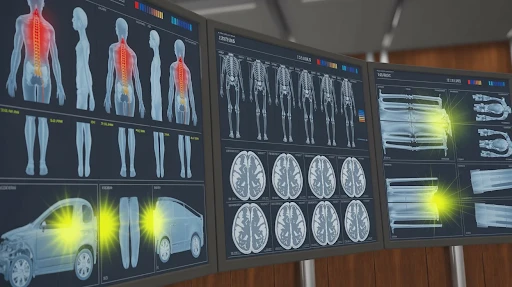
This is probably the most obvious place where legal visuals earn their keep.
In serious injury litigation, the legal team may need to explain anatomy, treatment, causation, and long-term effects without drowning the room in medical language. That is where medical demonstratives become useful. A jury may hear terms in a report and still have no real idea what happened inside the body or why a later limitation matters.
For that reason, many firms use personal injury animation services in cases where motion, force, or injury sequence matter to the damages story.
The same logic applies when lawyers rely on medical malpractice animation services to explain a missed step in treatment, a surgical error, or the progression of harm after a clinical failure.
The value is not that these visuals look sophisticated. The value is that they help the audience stop guessing.
Trial Graphics Are Broader Than Many Teams Assume
A lot of people reduce this category to boards and slides. In practice, it is broader than that.
Some cases benefit from complex mapping when location, land use, site conditions, or geographic change matter. Others require media production to capture visuals, film, or real-world context that cannot be adequately communicated using paper alone.
Some even benefit from physical models when the thing in question is too huge, too little, too detailed, or too dangerous to touch directly in court.
The wider point is simple. Different disputes need different visual tools. The smartest teams are not asking which graphic trend is popular. They are asking which tool best helps the audience understand the case.
And that is really the standard that matters.
Where Trial Graphics Usually Make the Biggest Difference
Some visuals help because they simplify a complicated point. Others help because they stop the case from feeling scattered.
That second point gets missed a lot.
A case may have strong exhibits, good experts, and a believable liability theory, yet still feel disjointed because the presentation changes shape every twenty minutes. One witness uses a timeline.
Another uses a medical image. Another relies on technical language with no visual support. By the time opening statement and closing argument arrive, the jury has seen plenty of information but not enough structure.
That is where good trial graphics can quietly hold the case together.
The best ones create continuity. They help the audience recognize the same concepts when they appear again in testimony, timelines, damage arguments, and expert explanations. That type of repetition is beneficial since it does not appear repetitious. It feels organized.
The Same Graphic Does Not Work in Every Setting
This is another place where teams sometimes over-assume.
A visual that works beautifully in trial may not be the right choice for pre-trial and summary judgment hearings. A demonstrative that helps in a mediation setting may not be the best version for a live witness. A dense chronology might be useful in internal client presentations, but far too heavy for a jury.
That is not a flaw. It is normal.
Different phases of litigation call for different levels of detail, pacing, and visual complexity. In witness statements and testimony, the visual usually needs to be easy to walk through under pressure.
In mediation, the objective may be clarity and leverage rather than complete story immersion. Visuals may need to undertake more fast orientation work at public hearings since the audience has less patience and background.
The mistake is treating all of those settings like they have the same communication demands. They do not.
Some Cases Need a Stronger Sense of Place
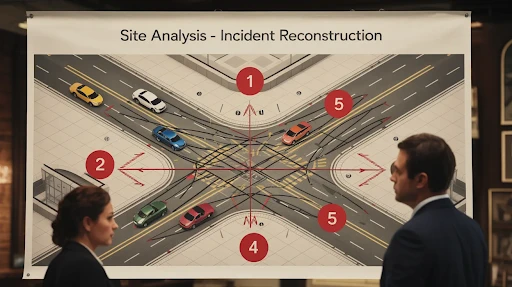
Not every dispute turns on place, but when it does, the visuals can carry a lot of weight.
Construction matters, environmental disputes, transportation cases, and site-specific injury claims often depend on geography, route, spacing, visibility, access, or physical layout. Written descriptions can handle some of that. Sometimes they cannot. That is where mapping, site views, drone footage, and layered diagrams become useful.
It is also where accident reconstruction animation services can help if the case depends on movement through a real-world setting. The legal team may need to show not only what happened, but where it happened, what could be seen, how distance affected decision-making, or why a sequence unfolded the way it did.
When those facts are central, the audience should not be forced to imagine the scene from scratch. That is usually a losing proposition in a technical case.
Frequently Asked Questions
What Are Trial Graphics in Litigation?
Trial graphics are visual aids that help communicate case facts, evidence, timelines, anatomy, technical procedures, and event sequences more clearly during litigation, hearings, mediation, arbitration, and trials.
When Should Lawyers Start Working on Trial Graphics?
Earlier than many teams do. The optimum moment is frequently while the case theory is developing, rather than when the trial is nearing its conclusion. Early drafts can help expose poor explanations and presentation gaps.
Are Trial Graphics Only Useful in Jury Trials?
No. They may also assist with bench trials, mediation, arbitration, expert presentations, tutorials, hearings, and internal strategy discussions when the team wants to communicate technical content more effectively.
What Types of Cases Benefit Most From Trial Graphics?
Cases involving technological, medical, historical, or geographical complexity typically benefit the most. This covers catastrophic injury lawsuits, product disputes, medical malpractice claims, transportation issues, construction conflicts, and commercial litigation.
How Do Trial Graphics Help Witnesses?
They provide witnesses with a clearer manner to guide the audience through challenging topics. When utilized correctly, they eliminate confusion, enhance sequencing, and keep the testimony focused on the important points.
Final Word
Trial graphics matter because complex cases rarely explain themselves. The most effective visual work assists legal teams in organizing complex information, supporting witness testimony, clarifying technical evidence, and keeping the audience engaged from beginning to end.
When done well, the graphics do not compete with the case. They make the case easier to understand, easier to remember, and much harder to misread.
Related Articles: