
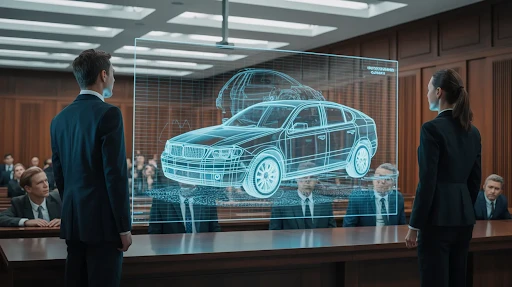
3D animation for attorneys helps turn hard case facts into something a jury can actually see and understand. Some legal issues are easy to explain with words. Others are not. A crash sequence, a spinal injury, a surgical mistake, a machine failure, or a building hazard may need more than testimony and photos.
That is where 3D legal animation helps. It gives the courtroom a clear visual path through the facts.
This guide explains how attorneys can use 3D animation in court, when it makes sense, and how to plan it without making the case look overdone.
Step 1: Start With the Problem the Jury May Not Understand
Do not start with the animation.
Start with the problem.
Ask one simple question: what part of this case will be hard for regular people to picture?
Maybe it is how the two vehicles moved before impact. Maybe it is how a disc injury happened in the spine. Maybe it is how a medical device failed. Maybe it is a surgical step that needs to be shown clearly.
This matters because 3D animation should not be used just because it looks impressive. It should solve a real communication problem.
If the jury can understand the point from one photo and one clear witness answer, animation may not be needed. But if the lawyer, expert, or witness keeps saying, “Imagine this,” that is usually a sign that a visual could help.
Step 2: Decide What Type of 3D Animation the Case Needs
Not all legal animation is the same.
Some animations explain movement. Some explain injury. Some explain a medical process. Some show a product failure. Some help with a timeline. The type of animation should match the case issue.
A courtroom animation company can help attorneys choose the right format. For example, a car crash case may need a 3D accident reconstruction animation. A medical case may need medical animation. A product case may need a visual showing how a part failed.
This is where attorneys should stay practical. The best legal animation is not always the longest or most detailed. It is the one that makes the point clear.
Courtroom animation should feel like an explanation, not a movie scene.
Step 3: Gather the Case Material Early
3D animation needs source material.
That may include photos, police reports, medical records, expert reports, measurements, product drawings, deposition testimony, videos, scans, or accident data.
The animation team cannot build a strong visual from vague notes. They need real case facts.
This is why attorneys should start early. Waiting until the last few weeks before trial can create problems. Experts may not have time to review drafts. Important records may be missing. Revisions may become rushed.
A simple folder with the right case material saves time later.
For trial graphics and litigation visuals, clean source material is the base of everything. If the foundation is weak, the animation will feel weak too.
Step 4: Involve the Expert Before the Draft Is Finished
The expert should not see the animation for the first time when it is almost done.
That is too late.
If the animation depends on expert witness testimony, the expert should help shape the visual early. They can confirm whether the sequence, anatomy, movement, timing, or technical detail is correct.
This is especially important for accident reconstruction animation services. A crash animation should match the reconstruction expert’s opinion. It should not guess at speed, braking, visibility, lane position, or point of impact.
The same rule applies to medical animation, product failure animation, and engineering visuals. The expert gives the opinion. The animation shows that opinion clearly.
If the two do not match, the other side may object. Worse, the jury may get confused.
Step 5: Use Animation to Connect the Event to the Injury
In personal injury cases, the jury often needs to understand two things.
First, what happened.
Second, how that event caused the injury.
A car crash may look simple in photos. A fall may seem small. A workplace impact may sound ordinary. But the injury inside the body may be serious.
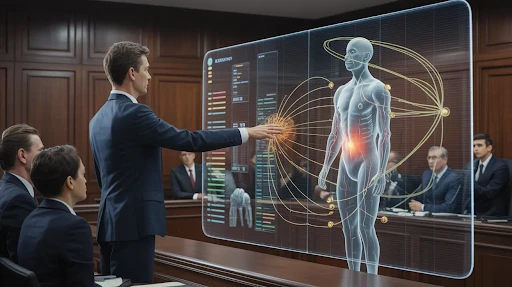
This is where personal injury animation services can help. A 3D animation can show how the body moved during an impact, how force traveled through the spine, or why a shoulder, knee, neck, or head injury makes sense.
This does not mean the animation should exaggerate the injury. It should not.
The goal is to help the jury understand the medical link. If the injury is hard to see from the outside, a clear 3D medical animation can explain it better than long records alone.
Step 6: Keep Medical Animation Calm and Accurate
Medical cases need extra care.
A surgical error, delayed diagnosis, nerve injury, internal bleeding, or treatment mistake can be hard for jurors to understand. Medical terms can lose people quickly.
That is why medical malpractice animation services can be useful. A 3D visual can show the body part, the treatment step, and the point where something went wrong.
But medical animation should never feel scary just to get a reaction. It should not use shocking colors or dramatic effects. That can make the visual look unfair.
The safest medical animation is simple and accurate.
It should be based on records, scans, expert reports, and medical review. It should help the expert explain the case in plain language. If the jury can see the anatomy and the sequence, the testimony becomes easier to follow.
Step 7: Make the Animation Easy to Follow
A busy animation can hurt more than it helps.
Too many labels, arrows, angles, and moving parts can overwhelm the jury. The point may get lost.
A good 3D trial animation usually moves slowly enough for people to follow. It uses simple labels. It shows one idea at a time. It does not try to explain the whole case in one visual.
For example, one animation may show a crash sequence. Another may show the injury. A timeline may show treatment history. A separate graphic may explain damages.
That is better than forcing everything into one long animation.
The jury should know exactly what they are supposed to see. If they are trying too hard to understand the visual, the animation is not doing its job.
Step 8: Use Demonstratives for the Right Parts of the Case
3D animation is often part of a larger visual plan.
A legal team may also need charts, timelines, medical illustrations, maps, or still trial graphics. These visuals help explain different parts of the case.
That is where demonstrative evidence services can help. A demonstrative does not need to be fancy. It needs to make a hard point easier to understand.
For example, a timeline can show when symptoms started. A 3D model can show where a product failed. A medical visual can show internal damage. A crash animation can show movement before impact.
Each visual should have one job.
When legal demonstratives are simple and focused, the jury has a better chance of remembering the main point.
Step 9: Review the Animation Like Opposing Counsel Will
Before using 3D animation in court, attorneys should review it carefully.
Do not only ask, “Does this look good?”
Ask better questions.
Is every major detail supported by evidence?
Does the expert agree with the animation?
Does it show anything that is disputed as if it were certain?
Does it look too dramatic?
Could the other side call it misleading?
This review matters. 3D animation can be powerful, so it must be fair. If it looks like it is pushing too hard, the judge may limit it, or the other side may challenge it.
The best courtroom visuals are easy to defend because they stay close to the record.
Step 10: Plan How the Animation Will Be Used in Court
A 3D animation should not just appear suddenly during the trial.
The attorney should know where it fits.
Will it be used during the opening? With an expert? During mediation? In settlement talks? During closing? The answer affects how the animation should be built.
If it supports expert evidence, the expert must be prepared to explain it. If it is utilized as a demonstration, the legal team should explain its objective. If it is exhibited during mediation, it may need to be shorter and more concise.
This is also where timing matters. Attorneys should leave time for revisions, expert review, and final approval.
Last-minute animation work usually creates stress. Early planning gives everyone more control.
Frequently Asked Questions
What Is 3D Animation for Attorneys?
3D animation for attorneys is a visual tool that helps communicate case facts, injuries, accidents, medical difficulties, and technical information more clearly.
When Should Attorneys Use 3D Animation?
Attorneys should utilize it when the jury may have difficulty understanding movement, timing, anatomy, product failure, or a complicated sequence based only on words.
Does 3D Animation Replace Expert Testimony?
No. The expert still gives the opinion. The animation helps the jury see and understand what the expert is explaining.
Can 3D Animation Be Used in Court?
Yes, it can be used in court when it is accurate, fair, based on evidence, and approved by the judge.
What Makes a Good 3D Legal Animation?
A good 3D legal animation is simple, accurate, based on real case material, reviewed by experts, and easy for jurors to follow.
Final Words
3D animation for attorneys is particularly beneficial when a case has facts that are difficult to describe with words alone. It can assist jurors in comprehending accidents, injuries, medical problems, product failures, and technological occurrences.
The trick is to utilize it cautiously. Begin with the problem, obtain credible source material, include the appropriate expert, keep the design basic, and ensure that the visual is consistent with the facts. Good 3D legal animation does not substitute testimony. It helps people comprehend it.
Related Articles: