
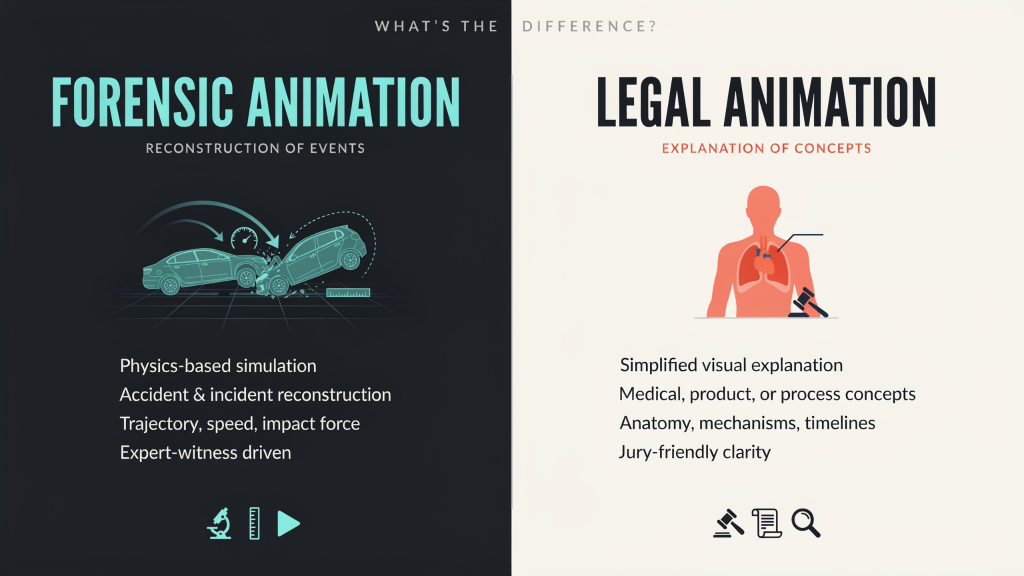
Forensic animation and legal animation get used as if they name the same thing. They don’t. Forensic animation is a reconstruction assembled from case evidence and expert analysis, produced to be shown in a proceeding and defended when opposing counsel objects.
Legal animation is the wider category, taking in those reconstructions alongside intake explainers, CLE modules, training video, and firm brand pieces. One carries an evidentiary burden. Most of the rest carry none at all.
That distinction decides what gets documented, who signs off, how long the build runs, and what a fair quote should look like.
Key Takeaways
- Forensic animation carries an evidentiary burden. Its job is to be shown in a proceeding and to hold up when challenged.
- Legal animation is the umbrella category. Forensic work sits inside it as the narrowest and most heavily controlled branch.
- The controlling question at intake is short: will a witness have to testify that this visual fairly represents the record?
- Federal Rule of Evidence 107 took effect on December 1, 2024, giving illustrative aids their own standard and their own vocabulary.
- Most late foundation problems trace back to a mislabeled deliverable at intake rather than to weak animation.
Forensic Animation Is Built to Survive a Foundation Challenge
Forensic animation is a visual reconstruction of a disputed event, assembled from the case record, guided by qualified expertise, and produced on the assumption that someone will attack it.
That last clause earns the word forensic. Scene geometry traces to measurements, surveys, or laser scans. Timing traces to signal data, dispatch logs, or reconstruction calculations. Injury mechanism traces to imaging and to what a treating physician can support on the stand. Where the record has a hole, the hole gets labeled rather than quietly filled with something plausible.
Consider a nighttime pedestrian collision. The vehicle’s path can come from skid measurements and an event data recorder download. Ambient illumination usually can’t, because nobody photometered that roadway at 11 p.m. two years ago. A forensic build treats the first as established and the second as a stated assumption, confirmed with the reconstructionist who’ll testify about it.
Render quality matters far less than buyers expect. A gray-box reconstruction tied cleanly to survey data is more defensible than a photorealistic scene built on inference.
The output looks like a video. The obligation behind it behaves like an exhibit, and a studio that can’t produce a source list on request hasn’t delivered forensic work.
Legal Animation Covers Far More Ground Than Most Intake Calls Assume
Legal animation is the category term, and the category is broad. It includes forensic reconstruction. It also includes a great deal of work that never comes near a courtroom.
A firm commissioning one might want an intake explainer walking claimants through how a mass tort proceeds, a CLE module on amended discovery obligations, a summary video for a demand package, or a brand film for the practice page. None of that has to survive a Rule 403 objection, and none of it needs an assumption log.
That breadth is why the vocabulary blurs. When a partner says the firm should do a video, the sentence describes an intent rather than a specification. Working out which matters genuinely call for a courtroom deliverable is separate work, and the types of cases that benefit most from legal animation shift considerably by practice area.
What Is the One Test That Separates the Two?
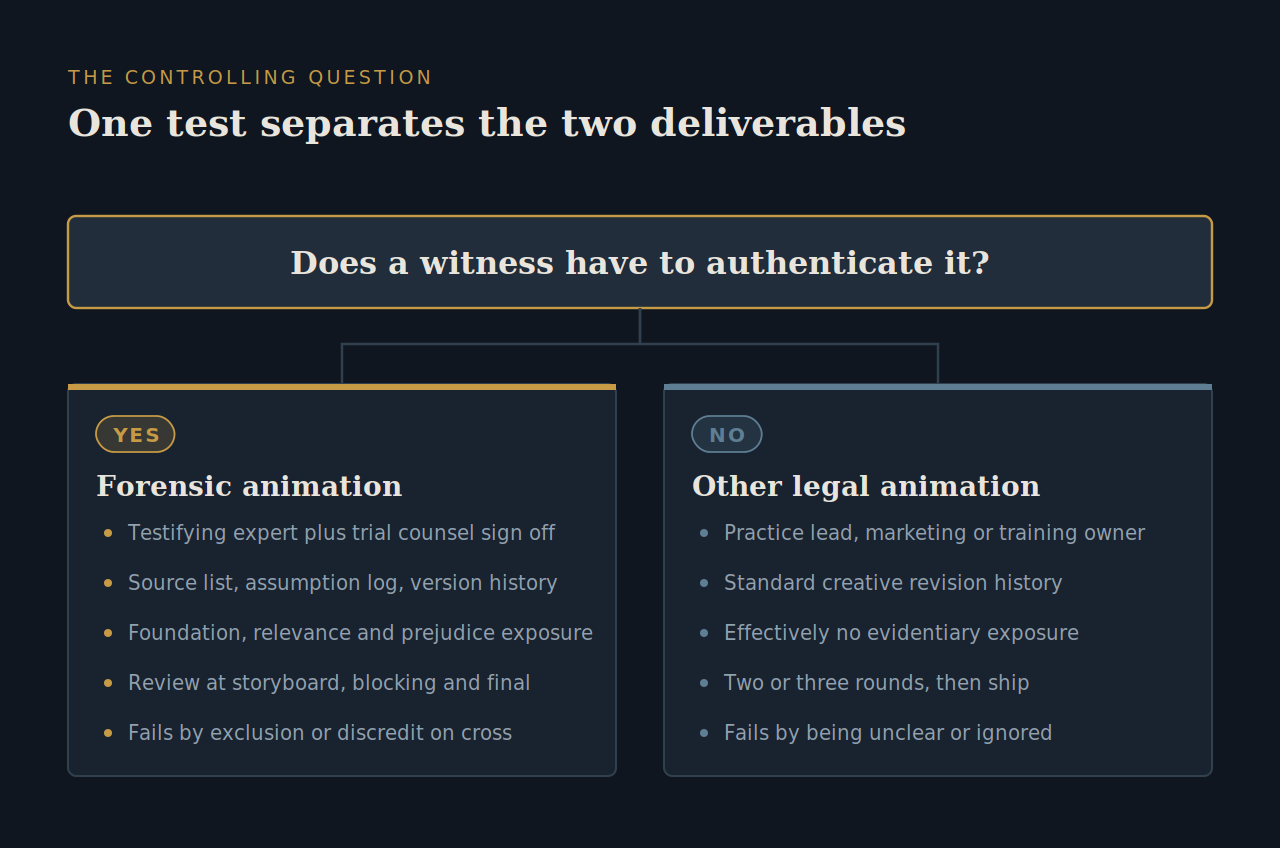
Ask a single question: does a witness have to authenticate it?
If a testifying expert or fact witness must take the stand and confirm that the visual fairly represents their opinion or the evidence beneath it, the deliverable is forensic. Everything downstream follows, including the documentation burden, the review calendar, the price, and what the studio owes your trial team when an objection lands.
If nobody has to authenticate it, because it lives on the firm website or inside a training deck, the answer is no. That work can still be first-rate. It simply runs under different rules.
Authentication is governed by Federal Rule of Evidence 901, and that provision quietly shapes most production decisions in forensic animation for court.
Two borderline situations recur. Mediation visuals often begin as non-forensic and get promoted when the matter refuses to settle. Demand-package graphics sometimes end up in front of a jury. Building either to the forensic standard from day one costs less than retrofitting it during trial prep.
Forensic Animation vs Legal Animation: A Side-by-Side Comparison
Here’s the split across the dimensions that change your workflow rather than the render.
| Dimension | Forensic animation | Other legal animation |
| Source of truth | Case record, measurements, expert analysis | Creative brief approved by counsel or marketing |
| Sign-off | Testifying expert plus trial counsel | Practice group lead, marketing, or training owner |
| Where it is shown | Deposition, mediation, trial presentation | Website, intake, CLE platform, internal LMS |
| Evidentiary exposure | Foundation, relevance, prejudice, sometimes Rule 702 | Effectively none |
| Documentation | Source list, assumption log, version history | Standard creative revision history |
| Handling of gaps | Flagged, disclosed, reviewed with counsel | Resolved by editorial choice |
| Typical failure mode | Excluded or discredited on cross | Off-brand, unclear, or ignored |
Where Each Deliverable Belongs in the Case Lifecycle
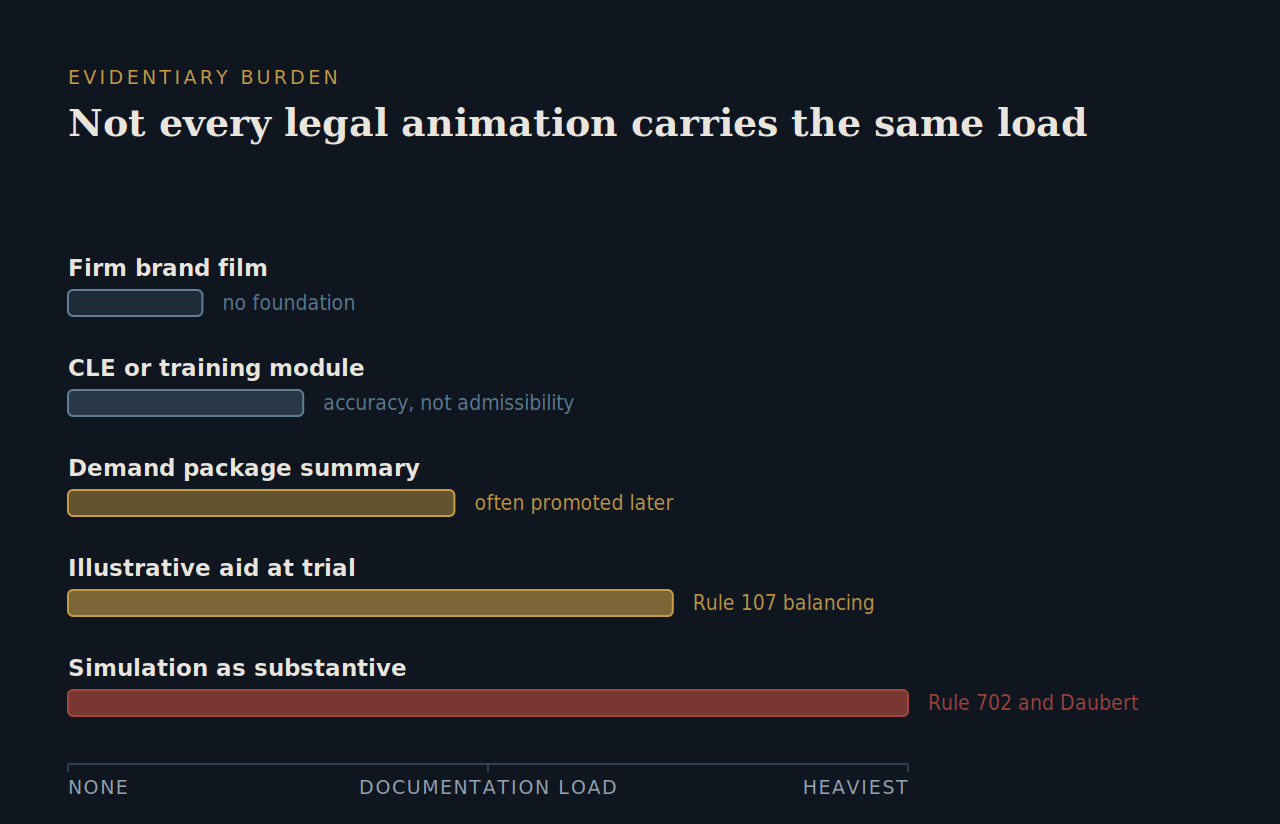
Sequence matters as much as category. A courtroom animation commissioned two weeks before trial arrives with almost no room for expert review, and that’s exactly when foundation problems surface.
Forensic deliverables cluster in the middle of a matter, and they compound. One verified scene model can support expert deposition prep in month four, a mediation cut in month seven, and a trial version in month eleven. Every version inherits the same source list.
Injury matters add a second track, since anatomy and mechanism need their own build. Teams handling medical animation for complex injury cases usually start that earlier than the scene reconstruction, because clinical review adds a round scene geometry doesn’t need.
Why Production Controls Change the Moment a Visual Becomes Forensic
Four controls separate a forensic build from a creative one, and none of them is visible in the finished file.
Source control. Every element ties to a numbered source: a deposition page, a photograph, a scan, an expert report, a chart note. When the question comes, the answer takes ten seconds.
Assumption logging. Anything interpreted rather than measured gets recorded, reviewed with counsel, and confirmed with the expert who’ll speak to it. Ambient light, pedestrian gait, and pre-impact head position are common entries.
Version history. Counsel can see what changed, when, and on whose instruction. That matters most when a disclosed draft and the final cut differ and the other side holds both.
Counsel checkpoints. Review lands at storyboard, at blocked animation, and at final, rather than once at the end.
There’s a records dimension too. Under Rule 107, an illustrative aid used at trial must be entered into the record when practicable, and it isn’t evidence, so it doesn’t go back with the jury unless all parties consent or the court orders otherwise. Clean labeling and organized output files aren’t housekeeping. They’re what makes that requirement painless.
Creative work runs two or three rounds of subjective feedback and ships.
Is It an Animation or a Simulation, and Why Does That Change Your Foundation?
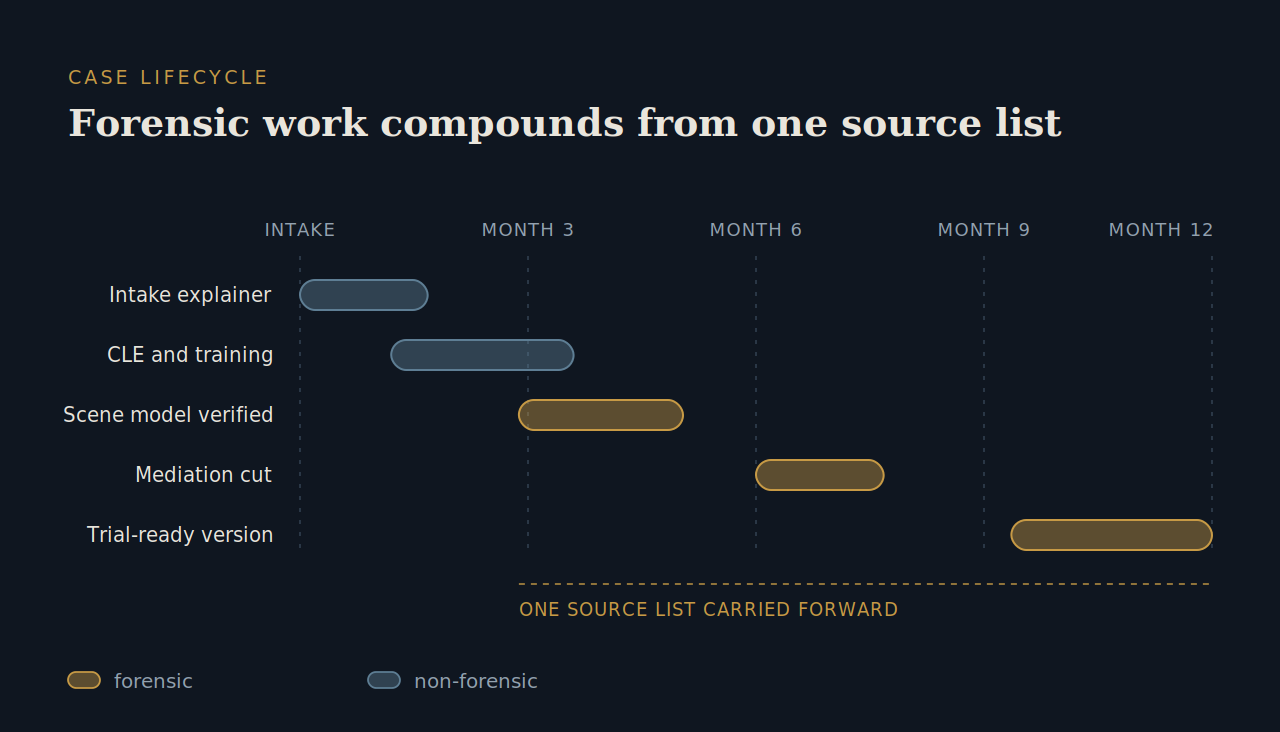
Before reaching admissibility, courts sort computer-generated visuals into one of two buckets. They determine first whether the exhibit is an animation or a simulation, and the two carry different standards of admissibility.
An animation illustrates what a witness or expert already says, functioning as a teaching aid. A simulation is different in kind, because the model itself produces the conclusion, and that’s what makes it substantive.
Since simulations usually arrive through expert testimony, challenges to them tend to come as Daubert motions. State courts have leaned on the same split, including Pennsylvania in Commonwealth v. Serge and Oklahoma in Harris v. State.
The classification isn’t cosmetic. It determines who lays the foundation, what you disclose, and which objections you should expect. So when you’re weighing a 3D animation for an attorney’s proposal, ask which of the two the studio is building. A vendor who finds the question pedantic is telling you something useful.
What Goes Wrong When a Firm Commissions the Wrong Deliverable
Firms sometimes ask for forensic legal animation and mean two entirely different things by the phrase. That’s where the trouble starts.
The costly direction is ordering creative work and later needing evidence. Nothing about the file is wrong. It just has no source list, no assumption log, and no expert in the loop, so nobody can authenticate it.
Timing compounds it. Computer-generated exhibits are often produced late in trial preparation, which invites timeliness objections, and courts routinely give cautionary instructions about the weight such exhibits deserve.
The wasteful direction runs the other way: forensic rates and forensic review cycles for a website explainer no judge will ever see.
How the Distinction Plays Out in Personal Injury Matters
Personal injury work sits on the seam, which is why the confusion surfaces here more than anywhere else.
One matter can easily need three visuals carrying three different burdens. A firm explainer helps a claimant understand the litigation calendar. A demand-package summary helps an adjuster grasp exposure. A reconstruction of the collision sequence, plus a mechanism-of-injury build, has to hold up against a defense biomechanist.
Only the third set is forensic. It needs the reconstruction expert early, the treating physician aligned with what the anatomy shows, and clear handling of anything the imaging doesn’t establish. Firms evaluating personal injury animation services should ask how a studio draws the boundary between what the record proves and what the record merely permits.
Credibility is the reason to keep the categories apart. A visual that overstates hands the defense an easy cross, and one weak exhibit colors how the jury reads the rest.
Budget and Timeline Diverge Sharply Across the Line
Published market ranges vary widely, and the spread mostly reflects burden rather than runtime. Single-scene reconstructions are commonly quoted in the $3,000 to $6,000 band. Multi-angle vehicle or pedestrian reconstructions typically land between $8,000 and $25,000.
Complex builds with several experts and multiple environments run from roughly $12,000 to $40,000 and upward. Non-forensic 2D explainer work often sits between $2,500 and $5,000.
Schedules split the same way. Timelines and map exhibits can move in a few business days. A straightforward medical sequence usually needs one to two weeks. Multi-scene reconstructions with mechanism builds and several camera angles commonly take four to eight weeks.
Phasing helps when a trial date is fixed. Commission the mediation and expert-prep versions first, then extend the same verified assets into a trial cut.
What Should You Ask a Studio Before Signing?
Five questions separate studios that understand the burden from studios that just produce attractive video. They’re worth asking on the first call.
- Are you building an animation or a simulation, and how does that change our foundation?
- What does your source list look like, and can we see a redacted sample?
- How do you record and disclose assumptions when the record has gaps?
- What support materials come with delivery, such as a source packet or witness slide notes?
- Who on your team has sat through a challenge to one of these exhibits?
Any provider of genuine forensic animation services should answer all five without hesitation. Studios selling legal animation services as a marketing product, or pitching legal animation for attorneys purely as a lead magnet, tend to stall on the first two.
Final Words
This isn’t a matter of vocabulary preference. One visual is built to be challenged; the other is built to be watched. Both carry real value, and confusing them at intake produces rebuilt exhibits, blown budgets, and foundation arguments a firm shouldn’t have needed to make.
Decide first whether a witness will have to authenticate the deliverable. Then choose accordingly.
If your matter needs work that can be sourced, defended, and used from deposition through verdict, talk to a legal animation production studio that treats the source list as part of the deliverable.
Frequently Asked Questions
What is the difference between forensic animation and legal animation?
Forensic animation is a reconstruction built from case evidence and expert analysis for use in a legal proceeding, where it can be authenticated and challenged. Legal animation is the broader category covering any animation produced for legal purposes, including client education, CLE training, and firm marketing. The forensic branch is distinguished by the evidentiary burden it carries.
Is forensic animation the same as legal animation?
No. The forensic form is a subset. The simplest way to separate them is to ask whether a witness will have to testify that the visual fairly represents the record or an expert opinion. If yes, the deliverable needs source control, assumption logging, and expert alignment. If no, it runs on a normal creative workflow.
What is forensic animation used for?
It shows sequence, timing, visibility, spatial relationships, and injury mechanism in matters where testimony alone leaves too much room for confusion. Common applications include vehicle and trucking collisions, premises incidents, product and industrial failures, aviation events, and injury mechanisms. Teams also use it for expert deposition prep and mediation, well before any trial date.
Can forensic animation be used in court?
Yes, though admission is never automatic. Courts weigh relevance, foundation, and whether the exhibit risks confusing or unfairly prejudicing the jury. Federal Rule of Evidence 107 took effect on December 1, 2024, and its Committee Note adopts the term illustrative aid in place of demonstrative evidence, reserving the latter for substantive evidence offered to prove a disputed fact. Whether a given exhibit is admitted or used only to assist understanding depends on the jurisdiction, the judge, and how counsel offers it.
How is forensic animation used in personal injury cases?
Typically in two tracks built separately. The first reconstructs the incident, drawing on scene measurements, photographs, video, vehicle specifications, and reconstruction analysis. The second explains the injury, built from imaging and records, and kept aligned with what the treating physician can support. Many firms commission both for mediation first, then refine them for trial if the matter doesn’t resolve.