
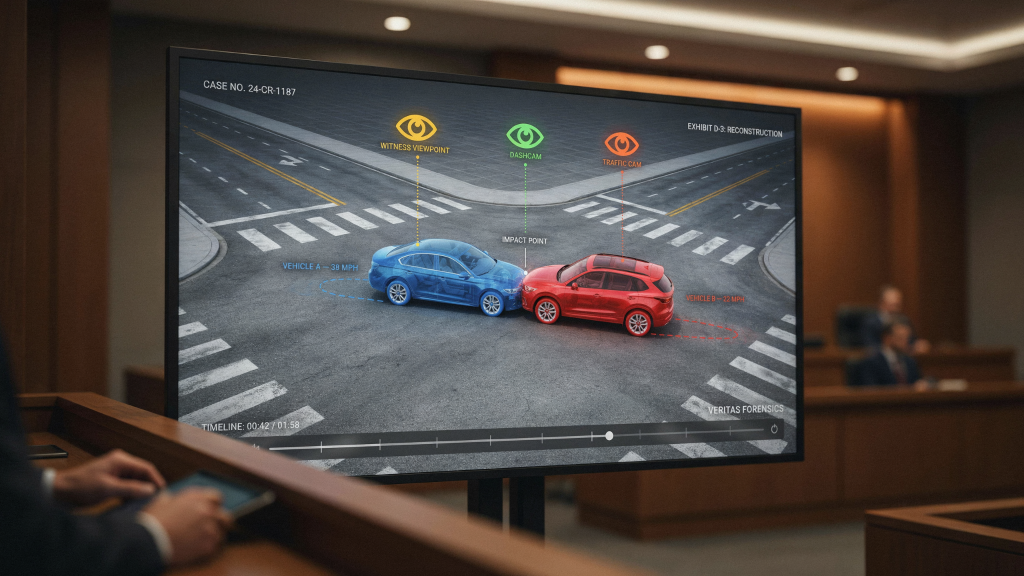
Forensic animation helps lawyers by converting a record that lives in transcripts, measurements, and expert reports into something a juror can watch once and follow. It doesn’t add facts. It removes the mental work of assembling them.
When a case turns on what happened in the two seconds before impact, or on whether a driver could see a pedestrian from 180 feet, testimony asks twelve people to build that picture privately and identically. Most of them won’t.
That gap between what the record establishes and what a juror actually pictures is where cases get lost. This is about closing it, and about the points where a visual makes things worse instead.
Key Takeaways
- Complex cases fail in four predictable places: sequence, space, elapsed time, and forces nobody photographed.
- A visual exhibit substitutes for the mental reconstruction jurors would otherwise perform alone and inconsistently.
- The research is mixed by design. Visuals improve recall and understanding in some conditions and distort judgment in others.
- Most value arrives before trial, in expert preparation, mediation, and motion practice.
- An exhibit that outruns the underlying record hands the other side a cross-examination it could not have built itself.
Complex Cases Lose Juries in Four Specific Places
Jurors don’t struggle with difficulty in the abstract. They struggle at identifiable points, and those points repeat across practice areas.
The first is sequence, meaning what happened in what order and what overlapped. The second is space, meaning distances, angles, and sightlines. The third is elapsed time, which people estimate badly under almost all conditions. The fourth is force, covering loads, pressures, and mechanisms that left no photograph.
Everything below works through those four. It’s worth noting at the outset that not every visual built for a firm carries an evidentiary burden, and the difference between forensic animation and legal animation decides which rules apply to yours.
Sequence Is the First Thing Testimony Cannot Hold Together
Testimony arrives in the order counsel asks questions. Events happened in a different order, and some of them happened at once. That mismatch isn’t trivial.
Take a construction fall. A safety officer describes the anchor point. A foreman describes the sequence of the lift. An engineer describes the failure. Each is coherent alone. Stitched together across three days of trial, the jury is being asked to hold a four-dimensional problem in working memory while a lawyer asks about something else.
A reconstruction collapses that. The anchor, the lift, and the failure appear on one timeline, with simultaneous events shown as simultaneous rather than consecutive. Nothing new enters the record. The assembly work simply moves from twelve untrained minds to one exhibit that everybody sees the same way.
That last point matters more than the visual polish. Consistency of understanding is the deliverable.
Spatial Relationships Are Where Words Fail Fastest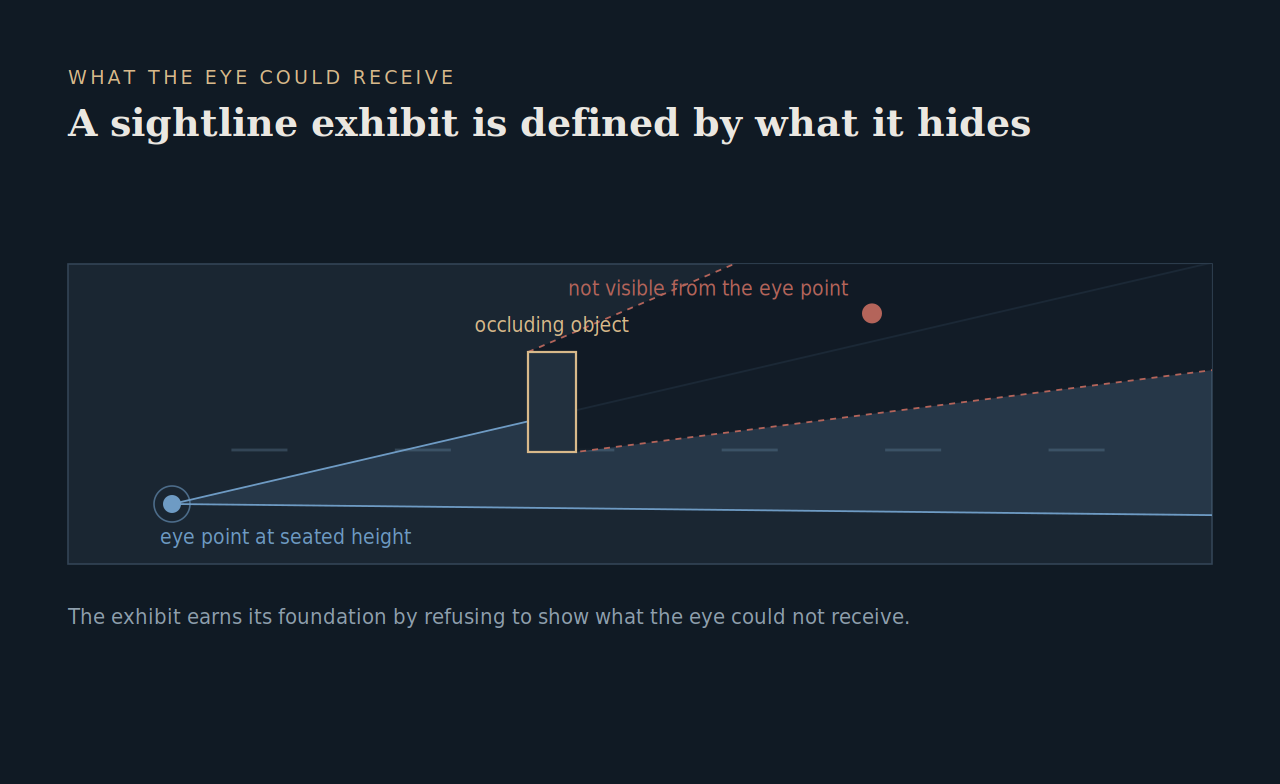
Ask someone to picture 180 feet. Then ask them to picture it at night, from a seated position, with a windshield pillar blocking part of the view.
Sightline questions defeat verbal description almost completely. An eye-point view from the driver’s actual seated height, with the actual pillar geometry and the actual headlight throw, answers in four seconds a question that three hours of testimony leaves unresolved.
The same problem shows up away from roadways. Premises cases turn on what was visible from a stairwell landing. Industrial matters turn on whether an operator could see a pinch point from the control station. Forensic 3D animation handles these because it can put a camera exactly where a human eye was and show only what that eye could receive.
Worth stressing: the value here is subtractive. A good sightline exhibit is mostly about what it refuses to show, which is why accident reconstruction animation earns its keep fastest in matters that turn on visibility.
How Do You Show Something That Took Under Two Seconds?
Jurors hear “he had time to react” and apply everyday intuition, which isn’t reliable at these durations.
Perception and reaction aren’t instantaneous, and the range is well documented. Federal Highway Administration guidance puts normal perception-reaction times at roughly 0.75 to 1.5 seconds, varying with alertness, fatigue, alcohol, and the driver’s age. Against a closing speed of 45 miles per hour, the slower end of that range consumes close to 100 feet before the brake pedal moves.
Nobody absorbs that from a number. Shown at real time, then again at quarter speed with a distance counter running, it becomes obvious. 3D animation for litigation is unusually good at this particular job, because time is the one dimension a static exhibit cannot represent at all.
Both directions work. Some cases need a compressed eight months of medical progression; others need 1.4 seconds stretched out until it can be examined.
Forces and Loads Have No Photograph
Nothing photographs a bending moment. Nothing photographs shear at a weld, cavitation in a pump, or the load path through a failed bracket.
These are the cases where testimony leans hardest on jargon, and where jurors quietly disengage. You won’t see it happen. An expert says the flange experienced cyclic loading beyond its endurance limit. That sentence is precise and, to a general contractor sitting in seat four, close to meaningless.
Jurors don’t ask for clarification. They just stop tracking, and nothing in the transcript records the moment it happened.
Presented as demonstrative evidence, a load-path visual turns that abstraction into something with direction and magnitude. Color encodes stress concentration. The failure initiates where the analysis says it initiated, and propagates the way the fracture surface shows it propagated.
The same logic covers injury biomechanics. A cervical mechanism argument rests on motion nobody recorded, and nobody can demonstrate on a living person. Anatomy plus motion, built to what the imaging supports, does what a spine model on a counsel table never quite manages.
What Changes When Jurors See Instead of Imagine
Here the honest answer is more useful than the confident one.
Peer-reviewed work on visual evidence doesn’t report a clean gain. A survey in Psychonomic Bulletin and Review found that visual exhibits sometimes improve recall and understanding, and sometimes impair judgment by triggering emotional responses, perceptual bias, or shallow processing. The effect depends on the circumstances.
Read that as an operating instruction rather than a warning. The gain shows up when the exhibit does genuine explanatory work, meaning it resolves sequence, space, time, or mechanism that testimony left ambiguous. The distortion shows up when the exhibit carries emotional weight the record doesn’t support, or when it looks more certain than the underlying analysis.
Which is why the discipline question and the persuasion question have the same answer. Build strictly to the record, and you get comprehension. Build past it, and you get a different effect, one you can’t control in deliberation.
The Exhibit Has to Match What Your Expert Will Say
An animation is only as good as the testimony it accompanies, and the failure mode is misalignment rather than inaccuracy.
The exhibit shows the vehicle at 38 miles per hour. Your reconstructionist, under cross, concedes a range of 34 to 41. Now the exhibit is more precise than the expert, and opposing counsel has a gift. Carry the range in the visual instead of a single value, agreed before anything renders.
That alignment takes longer when a matter needs several disciplines to agree on one picture. Firms coordinating expert witness services in cases that get technical fast shouldn’t assume the exhibit review fits inside an existing round. Anyone commissioning forensic animation for attorneys across multiple experts should budget a separate review cycle for it.
Where Do Lawyers Use It Before They Reach Trial?
Most matters resolve. Building only for a trial date misses where the return actually sits.
Expert preparation comes first. Walking your own expert through a reconstruction surfaces disagreements between the analysis and the visualization while there’s still time to fix either. That conversation is uncomfortable and cheap. The same conversation on cross is neither.
Mediation is second. An adjuster with authority responds to a two-minute courtroom animation differently than to a 40-page demand letter, because exposure stops being theoretical.
Motion practice is third and most overlooked. A summary judgment opposition that includes a visual showing the disputed fact is genuinely disputed does work no brief paragraph does. Trial animation, if the matter gets there, is usually a refinement of assets that already exist.
How Do You Brief a Studio So the Exhibit Holds Up?
Give a studio the record, not a conclusion. That’s the whole brief in one line.
A brief that says “show the truck ran the light” invites a vendor to animate your theory. A brief that supplies the signal timing sheet, the event data recorder download, the scene survey, and the reconstruction report invites them to build what those support, which is the only version that survives contact with the other side.
Name the ambiguities yourself. If the record is silent on ambient lighting, say so at the kickoff rather than letting someone guess and getting a night scene that becomes an issue. Attorneys evaluating a 3D animation for an attorney’s proposal should push on this specifically, because a studio’s handling of gaps predicts everything about how the exhibit performs later.
Then confirm who signs. An exhibit nobody will authenticate isn’t an exhibit.
Some Matters Do Not Justify the Spend
Three situations argue against it, and recognizing them early saves real money.
Straightforward facts are the first. A rear-end collision with a liability admission needs damages proof, not a reconstruction.
A thin record is the second. Building on inference produces something that looks authoritative and can’t withstand a foundation challenge.
The third is subtler. Some evidence resists explanation regardless of format. One study comparing imaging techniques found that jurors rated a 3D print easiest to understand, yet their grasp of injury cause and severity stayed limited across every format tested. The authors concluded that forensic medical evidence is inherently hard for a layperson to grasp. Litigation animation services can reduce that difficulty. They can’t remove it.
What Overreach Costs You on Cross
The risk running the other way is real and measurable.
In a mock trial study, participants who saw a computer-generated animation supporting the defendant’s account were markedly more likely to acquit than those shown a static image or no visual at all. The effect held whether or not other testimony corroborated the animated account. Its authors concluded that such animations may carry disproportionate influence compared with traditional demonstrative exhibits.
That finding cuts against the party using the animation as readily as it cuts for them. It is the empirical shape of the Rule 403 objection your opponent will make, and a well-prepared adversary will cite work like it.
3D forensic animation services that push past the record don’t just risk exclusion. They invite an argument that the exhibit was built to persuade rather than explain, and juries dislike being handled.
Final Words
The case for forensic animation for lawyers is narrower and more durable than the marketing version. It isn’t that juries prefer video. It’s that complex matters ask jurors to perform reconstruction work they aren’t equipped to do consistently, and a disciplined exhibit performs it once, in the open, where both sides can examine it.
Match the exhibit to the record. Match it to your expert. Deploy it in preparation and mediation, not only at trial.
If your matter turns on sequence, sightline, timing, or mechanism, the forensic animation company worth briefing is the one that builds to the record rather than to the theory. Send the file to a legal animation company in the USA that works that way.
Frequently Asked Questions
How does forensic animation help lawyers?
It shifts reconstruction work off the jury. Instead of asking twelve people to assemble scattered testimony into a coherent mental picture, counsel presents one version everybody views identically. Lawyers also gain a preparation tool, since walking an expert through a draft exposes weaknesses in the analysis while they can still be addressed.
Can forensic animation be used as evidence in court?
It can be used in court, though usually as an aid to testimony rather than as proof of a disputed fact in its own right. A witness must establish that the depiction fairly represents the evidence or the expert opinion behind it, and the court weighs relevance against the risk of unfair prejudice. Requirements differ between animations that illustrate testimony and simulations offered for their own analytical output, and they vary by jurisdiction.
How does forensic animation help explain complex evidence?
By targeting the four places comprehension breaks: sequence, spatial relationships, elapsed time, and forces that left no visual trace. A sightline view shows what a person could actually see. A time-scaled sequence shows how little room existed to react. A load-path visual gives shape to stresses that cannot be photographed.
How do lawyers use forensic animation in a case?
Typically across four stages. Expert preparation, where a draft tests the analysis. Mediation, where it makes exposure concrete for an adjuster. Motion practice, where it shows that a disputed fact is genuinely disputed. Trial, where it supports direct examination. Most firms providing forensic animation services for attorneys will build once and adapt the same verified assets across all four, so you shouldn’t be paying for four separate builds.
What is forensic animation used for?
For showing what the record establishes in a form a non-specialist can follow. Common subjects include collision sequences, machine and structural failures, sightline questions, injury mechanisms, and timelines spanning months of treatment. Firms offering forensic animation services for lawyers also apply it to deposition prep and settlement presentations, well before any trial date.
When should a lawyer use forensic animation?
When a central disputed fact depends on sequence, distance, timing, or mechanism, and the record is strong enough to support a build. Skip it when liability is admitted and only damages are contested, when the record supports nothing beyond inference, or when the dispute turns on credibility rather than physical events.